Research
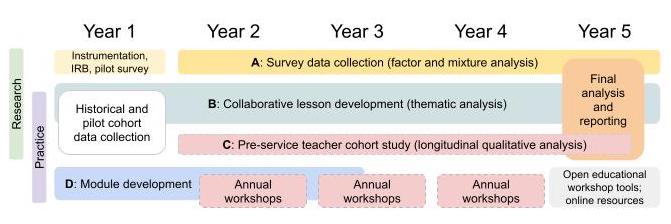
This five-year project employs a longitudinal mixed methods design to explore how international engagements shape educators’ awareness of the diaspora and perceptions of practice.
International Survey Study
A large-scale international survey will be conducted annually, using validated Likert-scale measures and scenario-based items to assess educators’ self-reported knowledge, beliefs, and competencies related to the African diaspora and teaching practice. The survey study will make use of a latent class mixture modeling method, a person-centered (vs. variable-centered) method, to generate a set of classes that group educators by their beliefs.
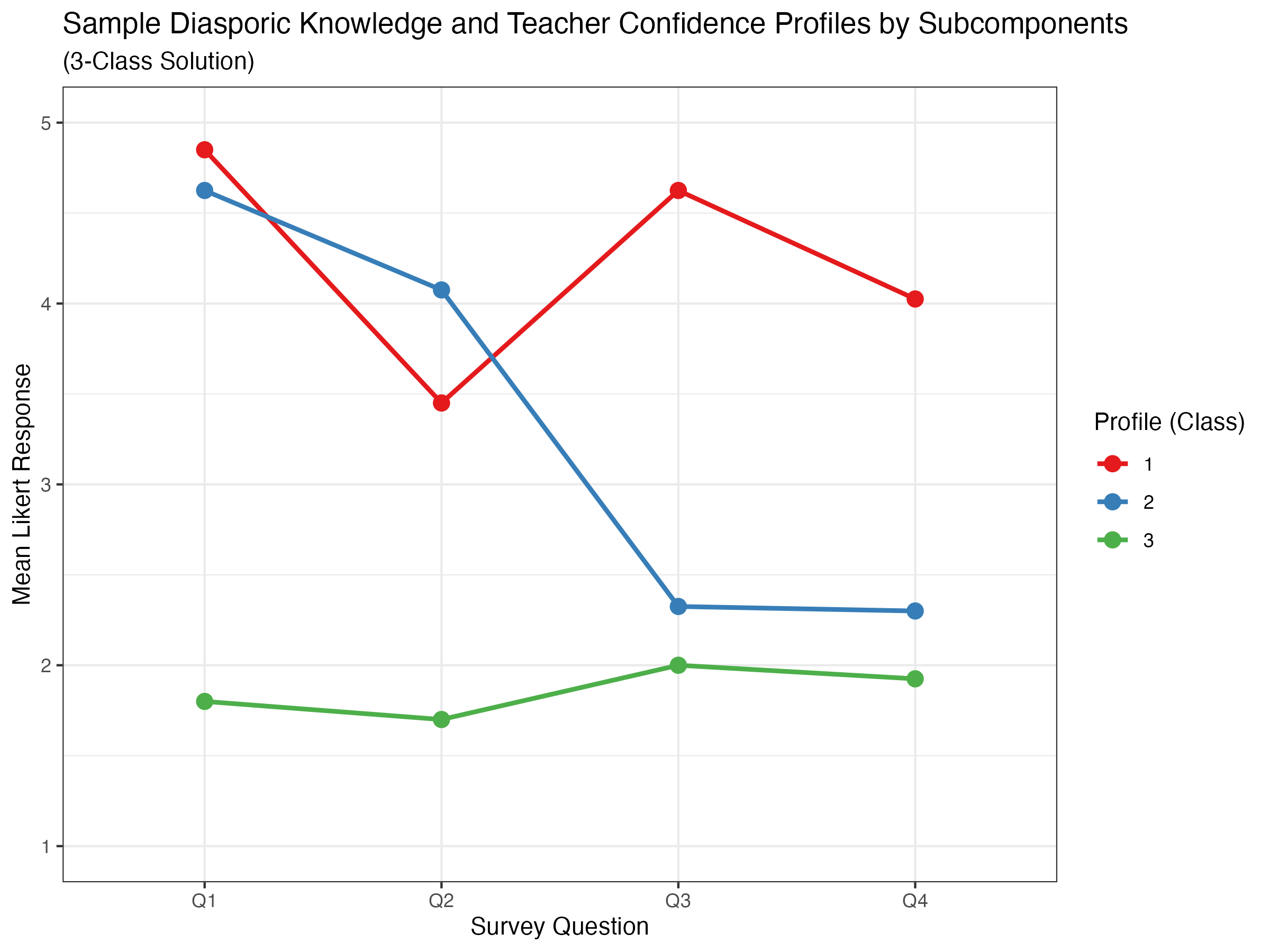
In Figure 2 (above), a sample 3-class profile is shown.
In this LCA plot, different classes present a person-centered (versus variable-centered) understanding of respondent responses. Q1 and Q2 (x-axis) are items related to awareness of the diaspora and Q2 and Q3 (x-axis) are items related to educators’ confidence teaching about the diaspora. The y-axis represents mean responses.
In the example, class 1 represents those respondents with high diaspora awareness and high confidence; class 2 represents those with high diaspora awareness but low confidence; and class 3 represents those with little or no diaspora awareness and low confidence.
Cohort Narrative Study
A cohort narrative study in collaboration with HBCU educator preparation programs will be run in Year 2 to 5.
The study involves longitudinal narrative analyses with cohorts of HBCU pre-service teachers and educators. Data collection methods include semi-structured interviews and focus groups, journals, and participant observations during virtual, hybrid, and in-person interactions to track shifts in diaspora awareness and professional identity.